
At Acquaint Softtech, a software product development partner for rental and PropTech platforms, the question operators raise most often is this: our screening tools return clean reports, so why do fraudulent tenants still get approved?
The answer is usually sequence, not software. Tenant screening and onboarding only works when identity is proven before anything else is checked, and when every decision is logged. This guide covers the checks that matter, the order to run them in, the regional rules, and the data model behind a flow you can defend.
The approach here reflects how Acquaint Softtech builds regulated verification workflows: an ISO 27001-certified team of 70+ in-house engineers, rated 4.9 out of 5 on Clutch, serving clients across the USA, UK, Europe, and Australia.
What tenant screening and onboarding is
Tenant screening and onboarding is the process of verifying a rental applicant’s identity, income, credit, and history, then moving the approved applicant into the tenancy digitally. Screening decides who qualifies; onboarding covers the lease, deposit, and account setup that follow.
Who relies on it, and why
Landlords use it to reduce rent default and fraud, property managers use it to apply one standard across many units, and applicants rely on it for a fast, fair answer. Each group needs a different view of the same decision record, so design for all three from day one.
The five checks that matter
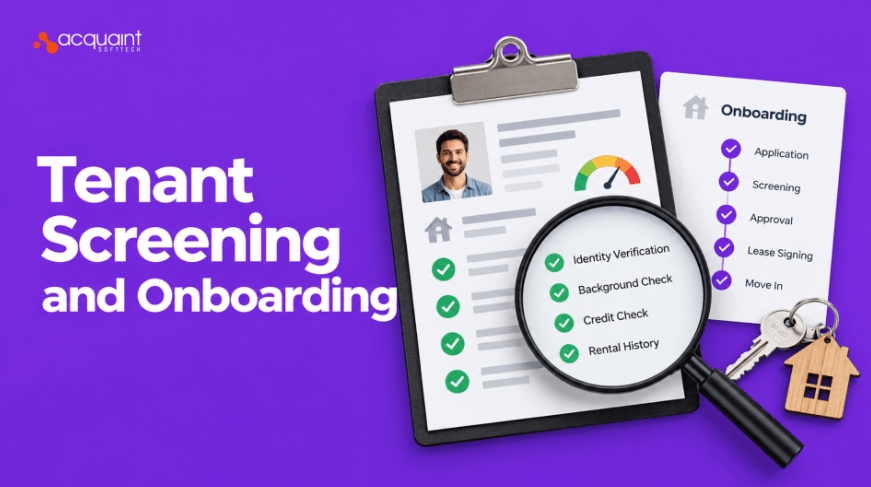
A complete screen checks five things: identity, income, credit, criminal and eviction history, and rental history. Each answers a different risk question, so skipping one leaves a blind spot the others cannot cover.
| Check | Question it answers | Common trap |
| Identity (digital KYC) | Is this a real person, and is it the applicant? | Accepting a photo of an ID with no liveness check |
| Income | Can they afford the rent? | Trusting uploaded PDF pay stubs |
| Credit | How do they manage debt? | Judging on the score alone |
| Criminal and eviction | Are there legal red flags? | Blanket bans that break local law |
| Rental history | Did they pay on time before? | Calling a reference the applicant supplied |
Why digital KYC must run first
Digital KYC must run first because every later check is only as reliable as the identity behind it. KYC (Know Your Customer) is a verification process borrowed from banking that confirms a person is who they claim to be.
What the fraud data shows
In a National Multifamily Housing Council (NMHC) Pulse Survey published in January 2024, 93.3% of 75 apartment owners, developers, and managers reported fraud in the previous 12 months. Of those, 84.3% saw falsified pay stubs or income documents, and 70.0% saw identity theft or fraudulent IDs.
Document, liveness, face, and data match
A strong KYC step checks the ID for tampering, confirms a live person is present, matches the selfie to the ID photo, and validates details against trusted sources. Ranking edge cases for human review is where AI development services add real value, because a model can spot edited documents and duplicate identities across applications.
Credit checks that stay compliant
A tenant credit check pulls a bureau report, with written authorization, to show how an applicant handles debt. Many screening services use a soft inquiry, a credit pull that does not lower the applicant’s score.
Adverse action and thin files
In the USA, the Fair Credit Reporting Act (FCRA) requires an adverse action notice when a report leads to denial, a higher deposit, or a co-signer. It must name the reporting agency and explain the right to a free copy. For thin credit files, accept verified bank data or a guarantor instead.
Background verification within the law
Background verification should confirm eviction history and relevant court records while staying within fair housing law. The US Fair Housing Act prohibits discrimination based on race, color, religion, sex, national origin, familial status, and disability.
Rules, not reviewer memory
Blanket criminal record bans can create disparate impact liability, meaning a neutral rule that disproportionately excludes a protected group. Local laws such as Cook County’s Just Housing Amendment go further, so encode lookback windows and excluded record types per jurisdiction.
Regional compliance at a glance
Screening rules differ by country, so multi-market platforms need region-aware logic instead of one global checklist.
| Region | Key rules | What the workflow must do |
| USA | FCRA, Fair Housing Act, local fair-chance laws | Authorization, consistent criteria, adverse action notices |
| UK (England) | Right to Rent, UK GDPR | Check before the tenancy starts; keep records |
| EU | GDPR | Lawful basis, data minimization, limited retention |
| Australia | Privacy Act 1988, state tenancy database rules | Disclose which tenancy databases are checked |
| India | DPDP Act 2023, police tenant verification | Capture consent; avoid storing Aadhaar copies |
The penalties are real
In England, repeat Right to Rent breaches can cost up to £20,000 per occupier. Under GDPR Article 22, EU and UK applicants can refuse decisions based solely on automated processing that significantly affect them.
The workflow and data model behind it
A defensible flow runs consent, KYC, income, credit, and background checks in order, then routes borderline cases to a person. The data model is what makes that flow auditable later.
Consent log and decision trail first
Store every authorization with a timestamp, record each check result as an event, and save which criteria produced each outcome. Integrating bureau, KYC, e-signature, and payment providers is the heaviest work, which is why many teams hire API developer specialists for it.
What drives the build effort
Build effort depends on how many checks, providers, and regions you support. Most platforms should integrate specialized providers and build only the orchestration layer.
| Scope | What you get | Main effort driver |
| First release | KYC, credit, e-signed lease, one region | Provider integrations and consent capture |
| Multi-region platform | Background rules, adverse action, retention, audit trail | Jurisdiction logic and compliance testing |
Where the savings are
Launch in one region with identity and credit first, then add background rules and new markets once the event log is stable. Retrofitting consent and retention later costs far more than designing them in.
Proof: a verification pipeline we shipped
Acquaint Softtech built an AI document intelligence system for Hybopay Finance Ltd., a Dublin lending fintech, between October 2025 and April 2026. Its challenge mirrors tenant income verification: financial documents had to be validated before reaching a credit decision. The account below is drawn from the client’s verified 5.0 Clutch review.
| Challenge | Solution | Result |
| Documents waited on manual verification | Custom AI data-extraction model that structures variables and flags anomalies | Documents validated quickly |
| Manual data entry caused errors | Checkpoints cross-verifying parsed data before any write | Data entry errors eliminated |
| Scope changed mid-project | Integrated squad with an internal web console and API layer | Every milestone completed on time |
CEO Gerhard Drobits wrote that the team “understood our constraints from the start and designed around them.” The takeaway for screening is simple: automate for volume, and send exceptions to a person.
FAQs
What is tenant screening?
It is verifying a rental applicant’s identity, income, credit, and history before approving a lease. A digital flow runs these checks in order and logs every decision.
Does a tenant credit check lower the credit score?
Usually not. Many tenant screening services use a soft inquiry, which does not affect the score. Confirm with your provider, since a hard inquiry can lower it slightly.
What documents does digital tenant KYC need?
Typically a government-issued photo ID and a live selfie for face matching. Income proof comes separately, ideally through a bank or payroll data connection.
What is an adverse action notice?
It is a notice US landlords must send when a screening report leads to denial or worse terms. It names the reporting agency and explains the right to a free copy.
Can AI approve or reject tenants alone?
It should not. GDPR Article 22 restricts solely automated decisions with significant effects, and fair housing risk makes human review of rejections the safer design.
What slows tenant onboarding most?
Manual steps: landlord references, court record searches, police verification, and document review. Automating identity, credit, and bank-based income checks removes most avoidable waiting.